Aurelius Consilium
120s Cinematic Explainer Film
A two-minute flagship explainer for Aurelius Encephalon's gamified ERP — structured around Roman Empire and chess metaphors, backed by detailed storyboards, style frames, and a Blender-to-After Effects pipeline.
The Brief
Aurelius Encephalon needed a flagship explainer video for their gamified ERP product, Aurelius Consilium. It had to attract investors and comprehensively explain the product within a two-minute runtime. Not a typical walkthrough. A pitch piece.
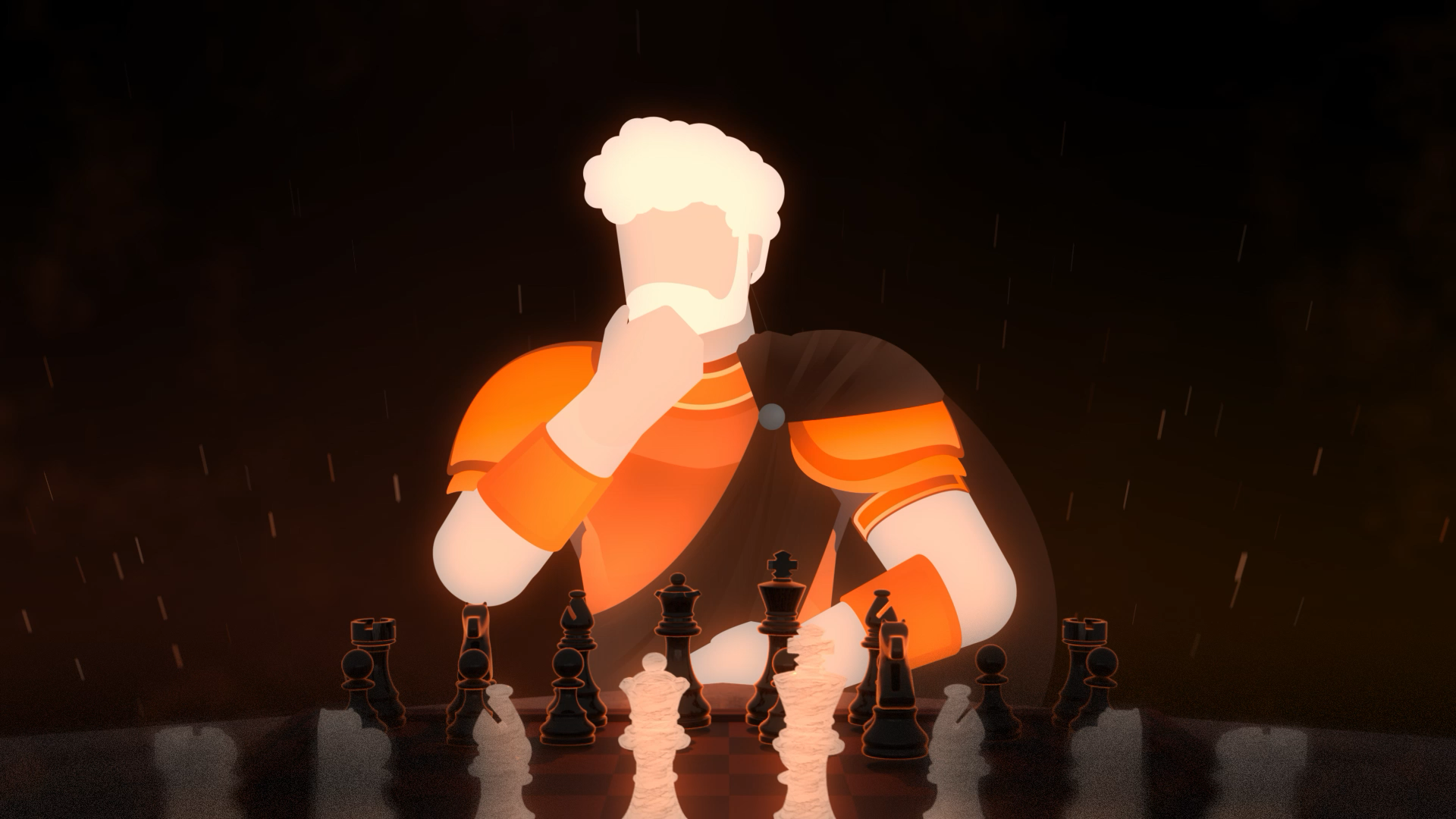 The client already had strong branding built around two metaphors: Marcus Aurelius and the Roman Empire, and chess. My job was to weave those into every layer of the video.
Structuring the Story Around Metaphor
The video opens with a soft hook that speaks to the investor mindset, then leans into the Roman Empire metaphor. Marcus Aurelius appears as a stoic emperor and transforms into a modern CEO. That transition bridges ancient wisdom into the business world. The middle section presents the ERP's components, features, and differentiators. We close by returning to the chessboard. Marcus Aurelius makes his final move. Checkmate. The entire narrative arc lives inside the metaphor.
Storyboard Focus
I used Milanote to map out each shot alongside the narration, which also helped me list the assets I'd need later. The board positions were drawn from actual chess games so they'd hold up to anyone who knows the game. The client responded well to these sketches. Seeing that level of detail early gave them confidence the production was headed in the right direction.
From Storyboard to Style Frames
I started with three style frames built in Illustrator and After Effects. Graphics, composition, and layout were blocked in Illustrator. Compositing elements like lighting, blurs, particles, and glows were added in After Effects. Some frames even used Blender so the 3D assets would be production-ready from the start. I placed each storyboard sketch side by side with its style frame so the client could immediately see how the rough drawings would translate.
The Look
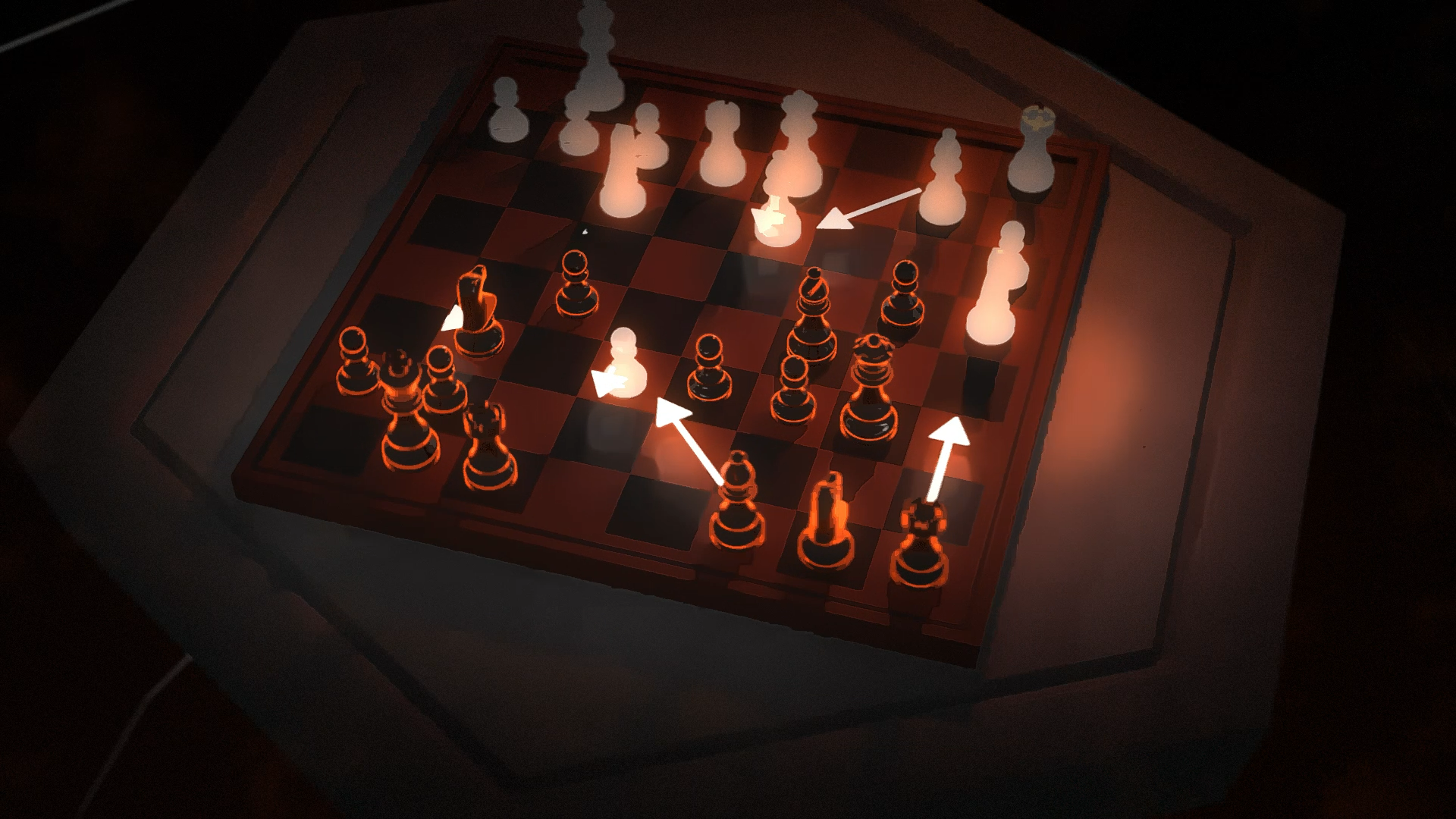 Orange monochrome. Orange, white, and black. Subjects pop in bright orange or white against deep black backgrounds with a subtle gradient. Particles in the background add dynamism to the slower, more deliberate scenes without competing with the main action.
Character Design
I sketched the Marcus Aurelius character by hand first to get the feel right, then built it out in Illustrator across several views. The design evolved as the story did. I stayed open to adapting along the way.
Blender to After Effects Pipeline
Several scenes required 3D in Blender, rendered as PNG sequences with transparent backgrounds and composited in After Effects. What comes out of Blender is never the final look. It's the base. Glow, particles, shadows, depth of field, all of that gets finalized in After Effects. I also exported camera data from Blender into After Effects. Blender's camera controls are far more maneuverable, so it made sense to set up the moves there and continue compositing in AE.
Physics and Simulation
The checkmate sequence uses a Blender modifier to decompose the king piece into fragments, converted into active rigid bodies. On collision with the queen, a keyframed outward point force triggers the explosion. Clean and physical. Another scene does the opposite. Chess pieces get pulled inward by a vacuum-like point force, converging into a central point before morphing into a laptop. It's the transition from the ancient Rome metaphor into the modern corporate world.
UI with Depth
Instead of placing UI elements on flat planes, I layered them onto the 3D chessboard environment with separated Illustrator layers at different Z-depths. When the camera moves, you get a parallax effect. Most software explainer videos skip this. If you're already in a 3D scene, you might as well use actual depth.
Camera Continuity
Directional continuity between scenes. If one exits with a clockwise orbit, the next enters the same way. If a scene exits on a zoom-in, the next one enters on a zoom-in. Subtle, but it keeps the eye tracking naturally through transitions.
Sound Design
Foley for the chess pieces, concrete abrasion sounds for the rougher textures, cinematic whooshes for transitions, and UI interaction sound effects for the interface sequences. The sound design ties everything together and gives weight to the motion.
The Result
A comprehensive yet compact explainer that balances inspiration with information. The cohesive dark look with strategic orange and white highlights keeps focus exactly where it needs to be. The pacing shifts between deliberate and energetic, holding interest across the full two-minute runtime.
Impact
A bootstrapped AU startup made a brand film that looks like it cost five figures, and that gap is a durable sales asset